

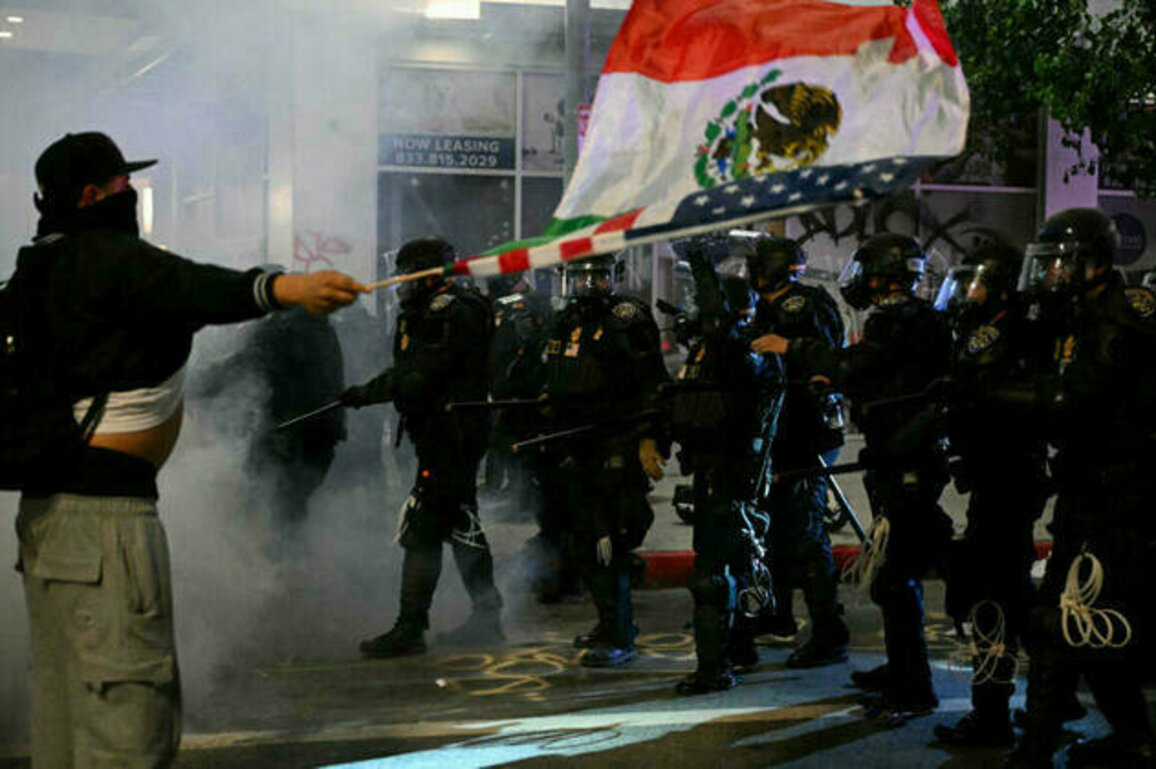
Thousands of Los Angelenos have taken to the streets after more than 40 migrants were arrested downtown by the Immigration and Customs Enforcement (ICE) on June 6. In the last four days, President Donald Trump has deployed 4,000 National Guard troops along with 700 Marines to the city. More than 50 people have been arrested, according to local law enforcement.
Protests in Los Angeles against US President Donald Trumps administrationcrackdown on immigration first broke out on June 6 after federal immigration authorities arrested more than 40 migrants in the city.
Trump responded by mobilising 4,000 National Guard troops along with 700 Marines over the last four days.
What triggered the protests?
Since Trumps return to the White House in January, his government has pledged to conduct the largest deportation operation in American history by expelling millions of immigrants in the country without legal status.
Immigration and Customs Enforcement (ICE) has been arresting undocumented immigrants for weeks.
Demonstrators protested against the deportation of mainly Latin American migrants from the city, which has a large diaspora from the region.
First demonstrations and clashes
Monday's demonstrations unfolded largely peacefully, however, after weekend protests triggered by dozens of arrests of people that authorities said were illegal migrants and gang members.
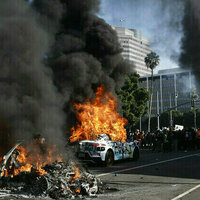
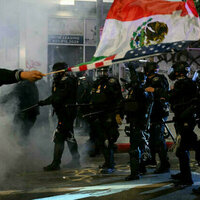
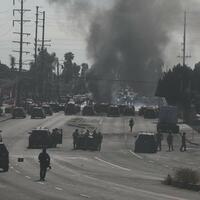
Portions of the 101 Freeway were closed over the weekend as protesters occupied its southside lane impeding traffic, tear gas filled the air and rioters torched self-driving vehicles, the Washington Post reported.
At least 56 people were arrested in two days, according to the Los Angeles Police Department.
Watch moreDozens held after Trump-ordered immigration raids in Los Angeles
Reaction of the White House
Trump responded by ordering the deployment of 2,000 National Guard troops on June 7 to California.
Trump said on Truth Social, that "Los Angeles would have been completely obliterated", if he hadn't deployed the National Guard.
White House Press Secretary Karoline Leavitt said late Saturday that the deployment of the troops aimed "to address the lawlessness that has been allowed to fester", blaming what she called California's "feckless" Democratic leaders.
"These lawless riots only strengthen our resolve," Trump posted on his Truth Social platform early on Sunday.
On Monday,the US president ordered the deployment of another 2,000 National Guard troops along with 700 Marines.
Trumps speedy deployment in California of troops against those whom the president has alluded to as insurrectionists on social media is a sharp contrast to his decision to issue no order or formal request for National Guard troops during the insurrection at the US Capitol on January 6, 2021, despite his repeated and false assertions that he had made such an offer.
US Defence Secretary Pete Hegseth said on his personal X account that he supported the deployment of troops to California, writing, We have an obligation to defend federal law enforcement officers even if Gavin Newsom will not.
'Deranged'
California Governor Gavin Newsom slammed the move as deranged, posting on X that US Marines shouldnt be deployed against Americans to achieve the fantasy of a dictatorial president".
The governor also criticised the announced mobilisation of 2,000 additional troops, claiming that the first to be sent in were reportedly given neither food nor water. Only approx. 300 are deployed the rest are sitting, unused, in federal buildings without orders, Newsom said on X.
California officials sued the Trump administration Monday, with the states attorney general, Rob Bonta, arguing that the deployment of troops trampled on the states sovereignty and pushing for a restraining order.
The last time the National Guard was activated without a governor's permission was in 1965, when President Lyndon B. Johnson sent troops to protect a civil rights march in Alabama, according to the Brennan Center for Justice.
Watch more(How) Do the LA protests compare to the 1992 riots?
Protests continue
Demonstrators accuse the Republican president of stirring up trouble.
"They're meant to be protecting us, but instead, they're like, being sent to attack us," Kelly Diemer, 47, told AFP. "This is not a democracy anymore.
Additional protests against immigration raids continued into the evening Monday in several other cities including San Francisco and Santa Ana, California, and Dallas and Austin, Texas.
(FRANCE 24 with AFP and AP)
Originally published on France24